Screen · Evaluate · Mitigate

Decision-grade risk, insurability, and resiliency intelligence for energy infrastructure capital.

Forward-looking, localized, asset-specific risk, insurability, and resilience intelligence — built for the owners, investors, and lenders financing the next $9 trillion of energy infrastructure.

See how it works ↓
The problem

Energy infrastructure is being repriced. Capital is still seeing different realities.

Weather, hazard, insurance, debt, and equity risk are moving as one system. But owners, investors, and lenders still evaluate the same asset with separate models, separate time horizons, and separate definitions of risk.

$380B
weather-driven infrastructure losses, 2023
Aon Catastrophe Insight, 2023
60%
of those losses uninsured
$228B protection gap
400%
insurance premium hikes in exposed corridors
Reinsurance market commentary
First: risk reprices through the capital stack
Step 1
Hazard event
Year 0
Step 2
Insurance reprices
Year 1
Step 3
Debt adjusts
Year 2–3
Step 4
Equity re-rates
Year 4–5+
Then: the response layer fragments

The same asset becomes three incompatible risk views.

Each party is asking a valid question. The failure is that the answers do not compose into one defensible view of the asset.

Owner

What action does this asset need?

Model focus
Exposure, insurability, resilience ROI
Output
Coverage strategy, resilience plan, capital allocation

Investor

What is the downside to the return case?

Model focus
IRR distribution, downside, terminal value
Output
Bid, hold/sell decision, equity check

Lender

Does this asset service debt under stress?

Model focus
Repayment capacity, DSCR coverage
Output
Loan size, rate, covenants

The fix is not another point model. It is one asset intelligence layer underneath all three decisions.

One physical and financial reality. Three decision contexts.
The solution

One asset intelligence layer. Three workflows.

InfraSure builds a forward-looking, localized, asset-specific model of each asset. It is part physical twin, part financial twin: site conditions, components, policy terms, debt assumptions, revenue mechanics, and resilience options all recompute through the same scenario engine.

The hazard exposure that surfaces a red flag in Screen drives the DSCR stress in Evaluate and prices the parametric trigger in Mitigate. Change one input — say, add a battery — and all three workflows recompute against it. Scenario analysis is built in, not bolted on.

Scenario paths for weather, hazards, prices, revenue, coverage, and DSCR.
Site-level hazard, grid, nodal, corridor, and market context.
Components, subsystems, policy terms, leverage, cashflow, and resilience levers.
Weather
Hazard
Grid
Equipment
Policy
Debt
Revenue
Resilience
Asset twin
physical state + financial structure + scenario engine
Screen
Evaluate
Mitigate
The same asset model supports screening, bankability, coverage, and resilience decisions.
1Workflow 1 of 3

Screen

Compare + Prioritize

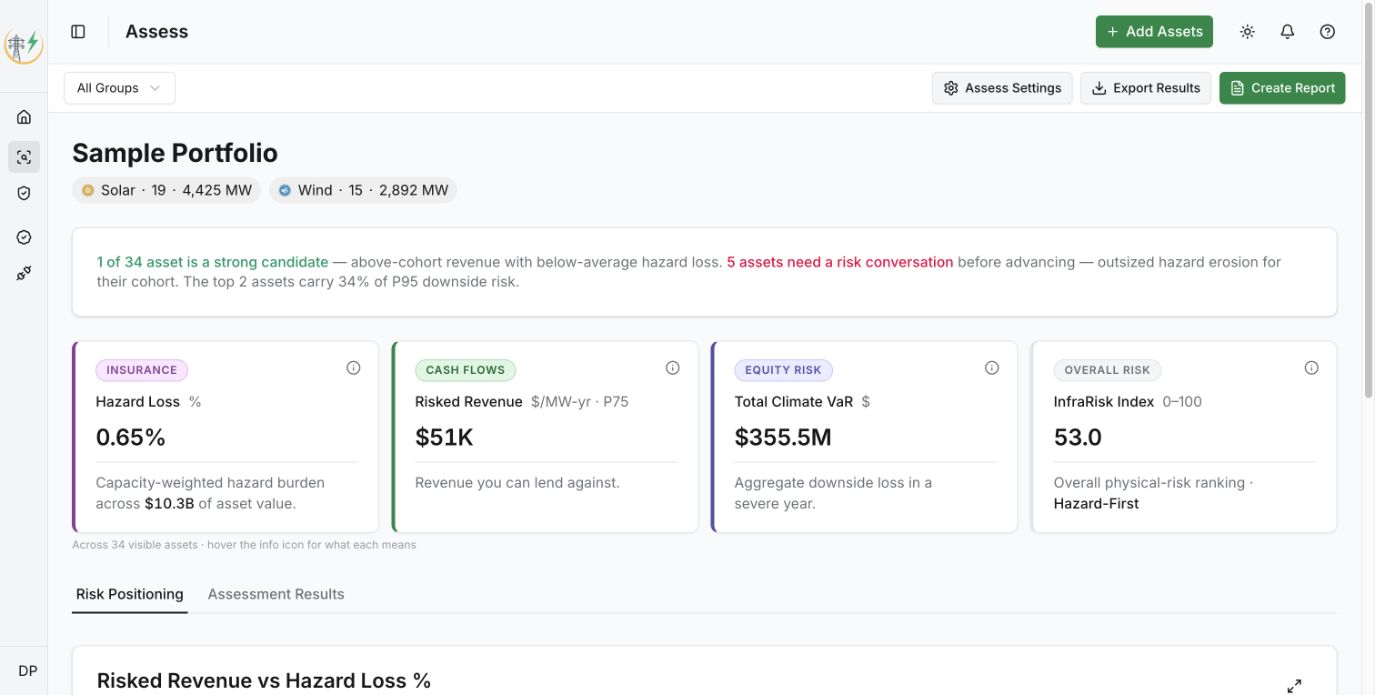
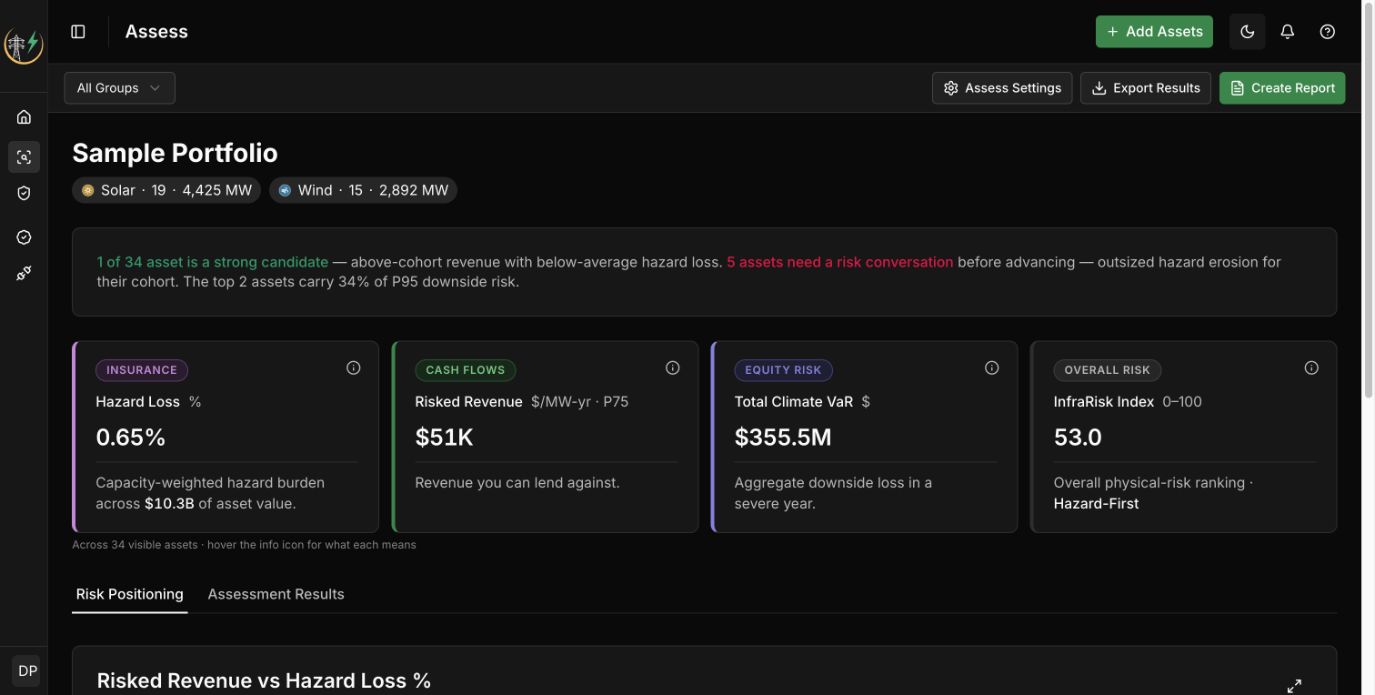
Score every asset on InfraRisk, decompose hazard exposure across 11 hazard types, and flag outliers against regional and national peers. The output is a ranked portfolio — an answer to which assets deserve deeper diligence, not a recommendation.

1.1
Load
Bulk-upload or pick from the 15K-asset registry; the models run automatically.
1.2
Screen
InfraRisk scores, hazard loss-ratio heatmap, and red-flag detection benchmarked against peers.
1.3
Prioritize
An evidence-grounded list of what deserves your diligence time.
app.infrasure.ai
Screen / Screening view — split-pane US map with hazard overlay plus a sortable table of 22 portfolio assets showing InfraRisk scores, hazard loss ratio percentages, adjusted revenue per kW, and red flag counts.
Sortable screening view across a 22-asset portfolio, with InfraRisk scores benchmarked against the continental US, hazard exposure decomposed across 11 hazard types, and red-flag detection per asset.
Screen / Comparisons view — InfraRisk summary comparing three solar assets (Great Bay Solar 1, Altavista Solar, Bakersfield 111) on score, revenue per kWp, and benchmark deltas against continental US and regional peers; below, a hazard loss-ratio heatmap across 11 hazard types per asset.
Side-by-side asset comparison: InfraRisk scores, benchmark-relative revenue per kWp, and per-hazard loss-ratio heatmap across 11 hazard types.
Screen / Comparisons view — Revenue vs Risk scatter plot positioning three assets on Natural Hazards Score versus Adjusted Revenue per kWp, alongside a Category Scores horizontal bar chart breaking each asset's score across Natural Hazards, Environmental, Buildability, Interconnection, and Revenue Risk dimensions.
Revenue-vs-risk scatter and category-score breakdown — surfaces which dimensions drive each asset's standing relative to the others.
Side-by-side asset comparisons across hazard types and revenue risk metrics
Revenue-vs-risk comparisons surfacing asset strengths and weaknesses
InfraRisk scoring benchmarked against continental, regional, or custom peer sets
Red-flag identification and analysis
Hazard loss-ratio heatmaps
Geospatial (down-scaled) drivers of hazard and asset evaluation

The output is not a recommendation. It's a prioritization — which assets in the set deserve the diligence time you do not have to spare.

2Workflow 2 of 3

Evaluate

Analyze + Quantify

When a specific asset matters, Evaluate is the workflow that earns the depth. The position you defend across operating, investment, and credit decisions — not a score.

2.1
Decompose
Asset-level hazard composition: EAL, VaR, PML decomposed by hazard and return period.
2.2
Forecast
Probabilistic generation and revenue paths against covenant thresholds.
2.3
Defend
Identify coverage gaps by hazard + configurable scenarios.
app.infrasure.ai
Sandy Ridge Wind Farm risk composition — total unmitigated EAL $58,762 with risk decomposed across hail (67.9%), hurricane (16.4%), strong wind (9.2%), and secondaries.
Identify key hazards and calibrate risk within entire asset composition.
Cashflow vs debt service chart — CFADS P10-P90 bands plotted against monthly debt service over a forward 12-month horizon.
Probabilistic CFADS forecast against debt service. Minimum P10 DSCR of 1.23x against a 1.35x covenant.
Coverage Gap by Hazard table comparing modeled hazard exposure to actual policy terms.
Coverage gap analysis: physical damage and revenue impact gaps surfaced per hazard at 500-year PML.
Hazard composition by asset (EAL / VaR / PML at 100yr, 200yr, 500yr)
Probabilistic generation forecasts (P50 / P90 / P99)
Bankability schedule with covenant stress detection
Insurance gap analysis by hazard and coverage layer
Business interruption exposure modeling
Configurable asset parameters with live re-modeling

The output is not a score. It's a position — a coherent, defensible read of the asset's economics and risk profile that the customer can act on.

3Workflow 3 of 3

Mitigate

Transfer + Adapt

Where analytical clarity becomes financial action. The same hazard distribution that drove the DSCR stress prices the parametric trigger.

3.1
Transfer
Parametric structures priced against the asset's modeled exposure.
3.2
Optimize
Coverage layers tuned to the actual hazard distribution, gap and surplus visible.
3.3
Adapt
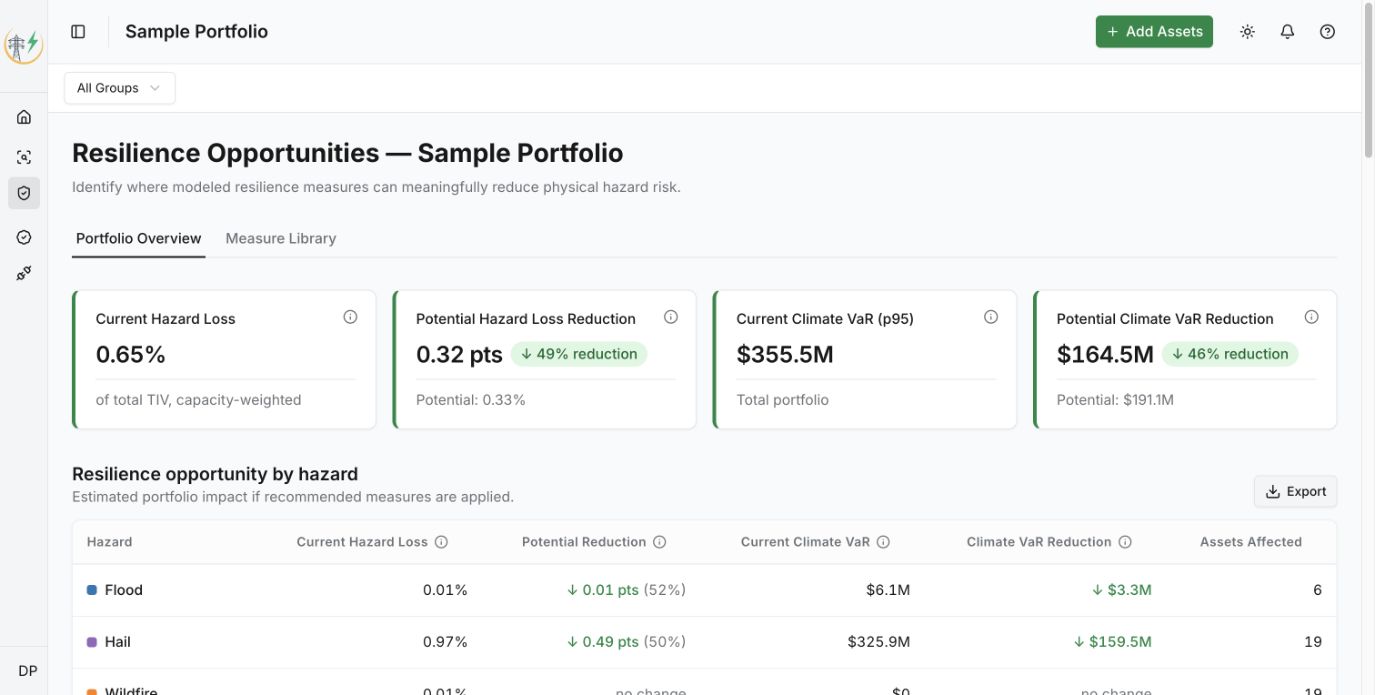
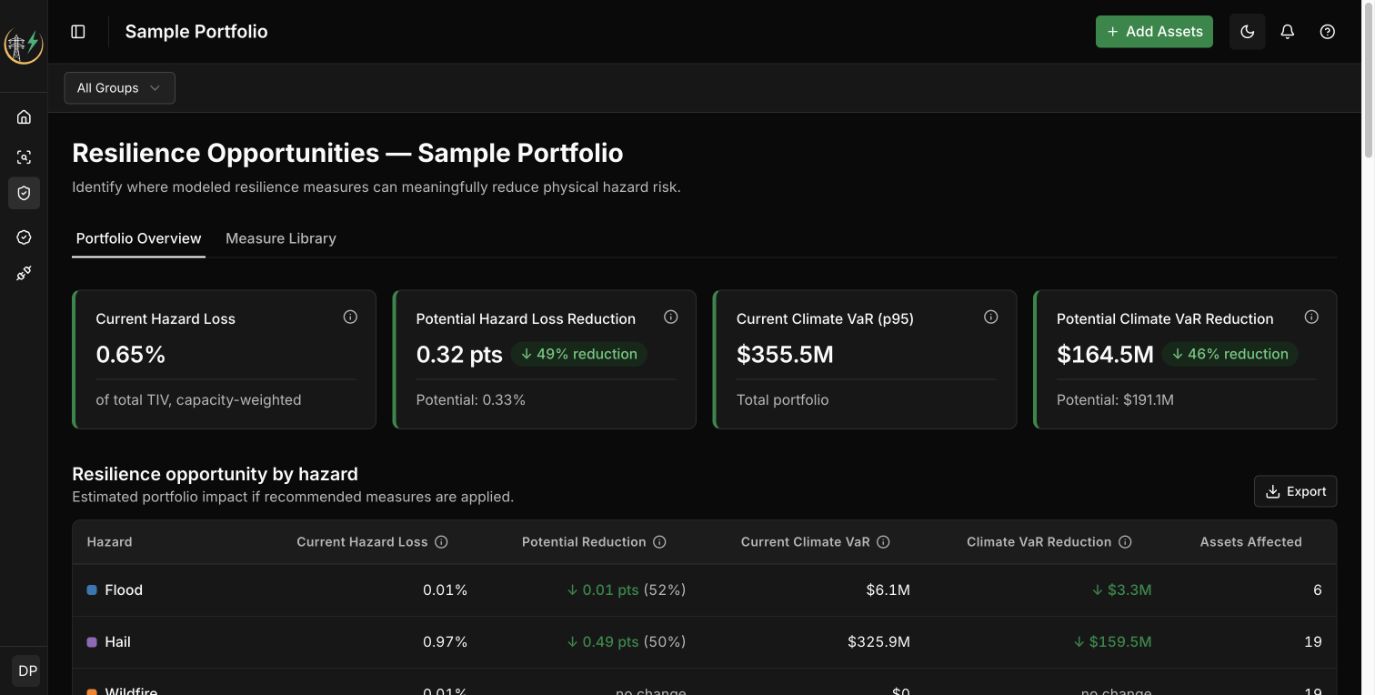
Resilience measures ranked by EAL reduction and cost-effectiveness.
Risk Transfer / Parametric Risk Coverage configuration screen.
Parametric structure configuration: protection level, analysis frequency, and result view tied to the asset's modeled exposure.
Mitigate / Adapt summary dashboard with Risk Transfer, Adaptation, and Resilience panels plus revenue/generation distributions.
Resilience measures ranked by EAL reduction, with insurance premium implications and revenue/generation distributions computed against the same scenarios.
Parametric structure design and trigger modeling
Coverage gap optimization across layers
Resilience spending ROI quantification
Adaptation ranked by cost-effectiveness
Composite mitigation stack modeling
Mitigation economics coherent with the evaluation view

The defining characteristic: the mitigation economics are not separate from the evaluation economics. The parametric trigger is calibrated against the same hazard distribution that drove the DSCR stress.

Why InfraSure

The advantages compound.

Each of these four advantages strengthens the others. The platform grows stronger with every asset added.

Data Foundation

45 years of ERA5 reanalysis at hourly resolution. CMIP6 climate projections. 8+ years of nodal LMP across CAISO, ERCOT, MISO, PJM, SPP. Full EIA + USPVDB + USWTDB + CEC + NOAA + FEMA integration.

Weather-to-Cashflow Coherence

A single scenario produces simultaneously a hazard outcome, a generation outcome, a revenue outcome, a DSCR outcome, and an insurance trigger — all for the same asset under the same path.

Market-Scale Coverage

Every utility-scale plant in the U.S. — not just owned assets. The benchmark surface widens with every asset added; the gap to second-best compounds with each one.

Validation Discipline

Generation hindcast against EIA monthly actuals (MAE <10%). Hazards calibrated against FEMA NRI. Tail risk cross-checked against TWIA, Verisk, Aon. Backtested against Katrina, Uri, Camp Fire, 2020 Derecho.

InfraSure’s advantage comes from combining market-scale coverage, unified modeling, and continuous validation in a single framework.

The open foundation

Every U.S. utility-scale plant. Every queue project. Every market signal. Open.

The same asset registry that powers our modeling layer is yours to explore.

Data centers coming soon
Ready to see it on your own portfolio?

Price the risk before the market does.

We’ll walk you through your own portfolio in 30 minutes — the screening view, the asset-level diligence, the mitigation economics. One asset of yours, end to end.

info@infrasure.ai